

Anti Aging Supplement Market to reach USD 12.54 Billion by 2035 at 7.8% CAGR
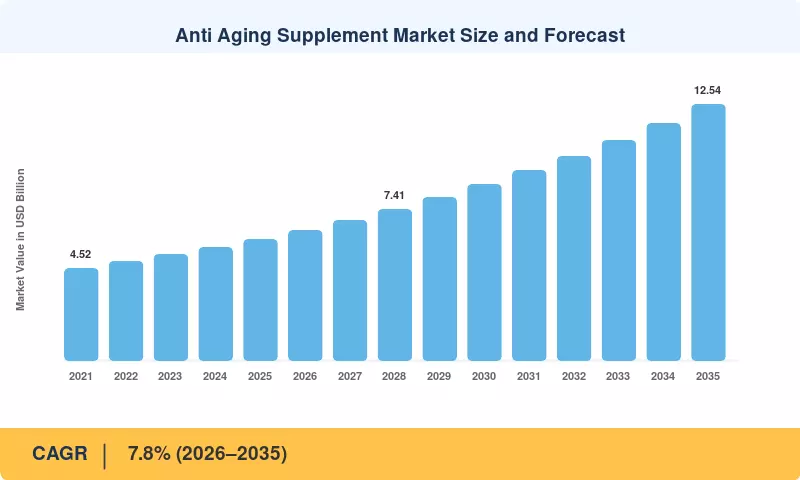
Anti Aging Supplement Market (2026 - 2035)
Anti Aging Supplement Market to Surge from USD 5.92 Billion in 2025 to USD 12.54 Billion by 2035—Powered by Global Population Ageing, Beauty-from-Within Demand
NY, CA, UNITED STATES, September 23, 2026 /EINPresswire.com/ -- As per Market Research Future, the global Anti Aging Supplement Market size is projected to reach USD 12.54 Billion by 2035 from USD 5.92 Billion in 2025, at a CAGR of 7.8% during the forecast period 2026–2035. The market base was estimated at USD 5.92 Billion in 2025, with the first year of the forecast period (2026) valued at USD 6.38 Billion. This growth trajectory reflects the convergence of demographic inevitability, shifting consumer attitudes toward ageing, and regulatory clarity that has reopened major distribution channels for evidence-based products.The 7.8% CAGR is propelled by three converging forces that reinforce one another across the forecast period. Global population ageing provides the demographic foundation, as the World Health Organization expects one in six people worldwide to be aged 60 or older by 2030 and anticipates that the number of individuals aged 60 and older will surpass 2.1 billion by 2050, creating a consumer base that is more proactive, wealthier, and healthier than previous cohorts. Beauty-from-within demand provides the commercial catalyst, as randomized trials demonstrating measurable skin elasticity improvements from daily collagen peptide supplementation give brands a credible claim platform, and consumers monitor results in the mirror, which drives repeat purchases. Mainstream supplement adoption provides the distribution foundation, as the Council for Responsible Nutrition's 2024 survey found that roughly three in four U.S. adults take dietary supplements, with healthy ageing among the leading stated reasons.
Request A Free Sample:
https://www.marketresearchfuture.com/sample_request/31164
Key Market Trends & Growth Drivers
Global Population Ageing and Healthspan Awareness
By the late 2070s, the United Nations anticipates that the number of individuals aged 65 and older will surpass that of those under 18, and the World Health Organization anticipates that the number of individuals aged 60 and older will surpass 2.1 billion by 2050. This results in a consumer base that is more proactive, wealthier, and healthier than previous cohorts, which is structurally expanding. Consumers now conceptualize supplementation in terms of healthspan, which refers to the number of years spent in good health, rather than disease treatment, and this shift in perspective broadens the appeal of supplementation to individuals in their 40s and 50s who are motivated by maintaining vitality rather than treating illness.
Beauty-from-Within Demand
Results that are readily apparent are persuasive, and a randomized trial that is frequently cited discovered that the elasticity of the skin was measurably improved within eight weeks when 2.5 grams of specific collagen peptides were taken daily. Brands are provided with a credible claim platform by studies such as this, and hair, skin, and nail products also generate substantial repeat purchases as consumers monitor their results in the mirror. Hyaluronic acid, ceramides, and antioxidants are being applied to collagen bases by brands in North America and East Asia in order to increase the average selling price, and this formulation strategy has been effective at differentiating products in an increasingly crowded market.
Mainstream Supplement Adoption
Supplement use is no longer niche, and the Council for Responsible Nutrition's 2024 survey found that roughly three in four U.S. adults take dietary supplements, with healthy ageing among the leading stated reasons. This broad base lowers customer-acquisition friction for anti-aging lines, since most buyers already hold a daily supplement habit, and retailers respond by expanding dedicated healthy-ageing shelf space in pharmacies and mass merchants. The mainstream adoption of supplements has transformed the anti-aging category from a niche interest into a mass-market opportunity that attracts investment from large consumer health companies.
Regulatory Clarity for NAD+ Precursors
Uncertainty held back the NAD+ category for years, and the FDA's 2025 conclusion that NMN can lawfully be marketed as a dietary supplement removed a major barrier in the largest national market. In Europe, EFSA's novel food assessment process for NMN provides a parallel pathway, and clearer rules encourage mainstream retailers to list cellular-health products they previously avoided. The resolution of regulatory uncertainty has unlocked significant investment in NAD+ product development and marketing, and this category is now among the fastest-growing segments within the Anti Aging Supplement Market.
Ask for Customization:
https://www.marketresearchfuture.com/ask_for_customize/31164
Market Segment Insights
BY FORMULATION
Capsules held a 33.4% share of the Anti Aging Supplement Market in 2025, supported by familiar dosing and broad retail acceptance, and brands can reformulate and extend lines with little change to manufacturing. Consumers trust the format across price tiers, and this versatility has made capsules the default choice for new product launches across multiple ingredient categories.
Powders are the fastest-growing format at an 11.5% CAGR through 2035, as high-dose collagen and daily drink rituals gain traction among consumers who have incorporated supplement use into their morning routines. Effective collagen doses often run 5 to 10 grams per day, which is impractical in capsule form, and this format gap supports the growth of powder products and favors brands with flavor and solubility expertise. Tablets generated USD 1.17 billion in 2025, anchored by mass-market multivitamin and antioxidant lines, while gummies are growing at 10.2% CAGR through 2035, driven by convenience and taste that appeal to first-time and younger buyers. Softgels held 11.6% of revenue through oil-based actives such as omega-3 and CoQ10, where the format provides superior bioavailability and stability compared to dry formats.
BY ACTIVE INGREDIENT
Antioxidants, collagen peptides, hyaluronic acid, resveratrol, and coenzyme Q10 represent the core active ingredient categories within the Anti Aging Supplement Market. Collagen peptides have experienced the strongest growth as clinical evidence has accumulated demonstrating measurable skin benefits, and brands have responded by incorporating additional actives such as hyaluronic acid and vitamin C to create differentiated formulations that support multiple benefit claims. Resveratrol and NAD+ precursors have attracted interest from consumers following longevity research, and the regulatory clarity that has emerged for NMN has accelerated product development in this category.
BY TARGET GROUP
Women represent the largest target group for anti-aging supplements, driven by beauty-from-within positioning and the established habit of skincare routines that supplement use naturally extends. Men are an increasingly important target group as male consumers embrace preventive health and performance optimization, and seniors represent a growing segment as the population ages and healthspan becomes a priority. Athletes and health-conscious individuals are driving growth in the performance and longevity subcategories, and these consumers typically have higher willingness to pay for premium formulations with clinical substantiation.
BY DISTRIBUTION CHANNEL
Retail pharmacies remain the dominant distribution channel in the Anti Aging Supplement Market, particularly in Europe where pharmacy-led distribution provides credibility and consumer trust. Online stores are the fastest-growing channel, driven by subscription models and direct-to-consumer brands that can educate consumers about ingredient science and clinical evidence. Health food stores retain a dedicated following among consumers seeking natural and organic products, while spas and salons represent a growing channel for beauty-from-within products that are recommended alongside topical treatments. Direct-to-consumer channels offer brands the highest margins and the most control over customer relationships, and this channel has attracted significant investment from both established companies and new entrants.
Read Detailed Insights:
https://www.marketresearchfuture.com/reports/anti-aging-supplement-market-31164
Regional Outlook
North America — Dominant Market (~37.8% Share, 2025)
The United States accounts for 81.4% of regional share within the Anti Aging Supplement Market, driven by the DSHEA framework and NMN regulatory clarity that has reopened mainstream retail channels for cellular-health products. The United States drives regional demand through a broad supplement user base, with roughly three in four adults reporting use, and a retail system spanning pharmacies, club stores, and online marketplaces that provides multiple touchpoints for consumer acquisition. The FDA's 2025 NMN decision is expected to bring NAD+ products back into mainstream retail, and this regulatory clarity has already stimulated investment in product development and marketing.
Canada holds USD 0.24 billion in revenue through Natural Health Products licensing that supports consumer trust by requiring pre-market approval and evidence review. The Canadian regulatory framework slows launches compared to the United States, but it also supports consumer confidence and premium pricing that offsets the longer time to market. Mexico is growing at 8.4% CAGR through 2035, driven by pharmacy chain expansion and direct selling that is bringing supplement products to a rapidly expanding middle class.
Europe — Second Largest (USD 1.62 Billion, 2025)
Germany holds 21.6% of regional share within the Anti Aging Supplement Market, driven by pharmacy channel dominance and a consumer culture that values evidence-based health products. Strict claims rules under Regulation (EC) No 1924/2006 shape how brands position products in Europe, and companies rely on authorized claims for vitamins such as vitamin C, which contributes to normal collagen formation, rather than direct anti-aging language.
The United Kingdom contributes USD 0.27 billion through online retail and beauty-from-within adoption that has made the UK one of the fastest-growing markets for collagen and skin health supplements. France is growing at 6.8% CAGR through 2035, driven by parapharmacy distribution that leverages the country's dense network of health and beauty retail outlets. Italy holds 11.9% of regional share through pharmacy-recommended collagen products that benefit from pharmacist endorsement and consumer trust. Spain generated USD 0.12 billion in 2025 through ageing population and pharmacy retail, while the Nordic countries are growing at 7.9% CAGR through 2035, driven by high supplement literacy and consumer willingness to pay for premium products.
Asia-Pacific — Fastest-Growing Region (9.6% CAGR, 2026–2035)
China holds 34.8% of regional share within the Anti Aging Supplement Market, driven by cross-border e-commerce and the SAMR health food system that governs product registration. Close to 30% of Japan's population is aged 65 or older, sustaining long-standing demand for collagen drinks and functional foods, although the 2024 beni-koji incident forced stricter rules that have increased compliance costs for smaller brands. Japan generated USD 0.36 billion in 2025 through its super-aged society and Foods with Function Claims system that allows evidence-based claims for functional ingredients.
India is growing at 12.1% CAGR through 2035, driven by FSSAI 2022 regulations that provide a clearer compliance pathway and rising urban incomes that are expanding the consumer base for premium supplements. South Korea holds 11.6% of regional share through an inner-beauty culture tied to the cosmetics sector, where supplement use is integrated with skincare routines. ASEAN markets are growing at 10.8% CAGR through 2035, driven by middle-class growth and marketplace retail that is making supplements accessible to consumers across the region.
South America — Growing Presence (5.1% Share, 2025)
Brazil holds 58.7% of regional share within the Anti Aging Supplement Market, driven by the ANVISA supplement framework and collagen popularity that has made the country the largest market for anti-aging supplements in Latin America. ANVISA's 2018 food supplement framework, established under RDC 243/2018, standardized permitted ingredients and labeling, which encouraged multinational brands to expand local portfolios. Collagen powders sell strongly through pharmacies and beauty retail, and this channel strength has attracted investment from both global brands and local manufacturers.
Argentina is growing at 7.6% CAGR through 2035, driven by pharmacy-led recovery in consumer spending after several years of economic challenges. The rest of South America generated USD 0.07 billion through direct-selling networks in Colombia, Chile, and Peru, where companies such as Herbalife and Amway have established distribution infrastructure that reaches consumers outside major metropolitan areas.
Competitive Landscape and Recent Developments
Competition is moderately fragmented within the Anti Aging Supplement Market, with the top five companies holding an estimated 32% to 38% of global revenue and the Herfindahl-Hirschman Index estimated at 500 to 700, indicating low-to-moderate concentration. Multinational nutrition groups compete with direct-selling companies, specialist NAD+ brands, and hundreds of D2C entrants, many relying on contract manufacturers, and this structure creates opportunities for differentiated brands while also creating pressure on commodity products that compete primarily on price.
KEY COMPANIES AND RECENT MILESTONES
Nestlé Health Science (July 2025): Announced a strategic review of mainstream vitamin brands while prioritizing premium lines such as Pure Encapsulations and Vital Proteins, demonstrating the company's focus on premium portfolio segments where clinical substantiation and brand differentiation support higher margins. The company maintains premium portfolio focus with pharmacy and practitioner reach. Estimated revenue share is approximately 8% to 11%.
Amway (Nutrilite): Operates direct-selling scale across Asia-Pacific with Nutrilite beauty and healthy-ageing lines that benefit from personal relationships between distributors and consumers. Estimated revenue share is approximately 6% to 9%.
Herbalife: Maintains distributor-led personalized nutrition with collagen skin boosters and cellular nutrition products that leverage a global network of independent distributors. Estimated revenue share is approximately 5% to 8%.
Haleon: Leads mass-market pharmacy with Centrum healthy-ageing multivitamins that benefit from broad retail distribution and brand recognition. Estimated revenue share is approximately 4% to 7%.
Pharmavite (Otsuka): Offers retail breadth and quality verification with Nature Made healthy-ageing and beauty lines that emphasize USP verification as a point of differentiation. Estimated revenue share is approximately 4% to 6%.
Niagen Bioscience (March 2025): ChromaDex rebranded as Niagen Bioscience, sharpening its focus on NAD+ science and healthcare-linked channels. The company is the NAD+ category pioneer with clinical focus on nicotinamide riboside. Estimated revenue share is approximately 1% to 3%.
Future Outlook: 2026–2035
The Anti Aging Supplement Market is projected to reach USD 12.54 Billion by 2035, growing at a CAGR of 7.8%, driven by global population ageing, beauty-from-within demand, and mainstream supplement adoption. Several emerging trends will shape the competitive landscape over the forecast period and determine which brands capture disproportionate value.
More Related Research Insights:
https://www.marketresearchfuture.com/reports/pharmacogenomics-market-1177
https://www.marketresearchfuture.com/reports/oncology-biosimilars-market-21979
https://www.marketresearchfuture.com/reports/bladder-cancer-market-1899
https://www.marketresearchfuture.com/reports/veterinary-service-market-42245
https://www.marketresearchfuture.com/reports/human-genetics-market-714
https://www.marketresearchfuture.com/reports/atomic-spectroscopy-market-11723
https://www.marketresearchfuture.com/reports/medical-automation-market-5184
https://www.marketresearchfuture.com/reports/orthopedic-trauma-devices-market-2080
https://www.marketresearchfuture.com/reports/next-generation-biomanufacturing-market-21984
https://www.marketresearchfuture.com/reports/pharmaceutical-sterility-testing-market-10720
Market Research Future
Market Research Future
+1 855-661-4441
email us here
Legal Disclaimer:
EIN Presswire provides this news content "as is" without warranty of any kind. We do not accept any responsibility or liability for the accuracy, content, images, videos, licenses, completeness, legality, or reliability of the information contained in this article. If you have any complaints or copyright issues related to this article, kindly contact the author above.
